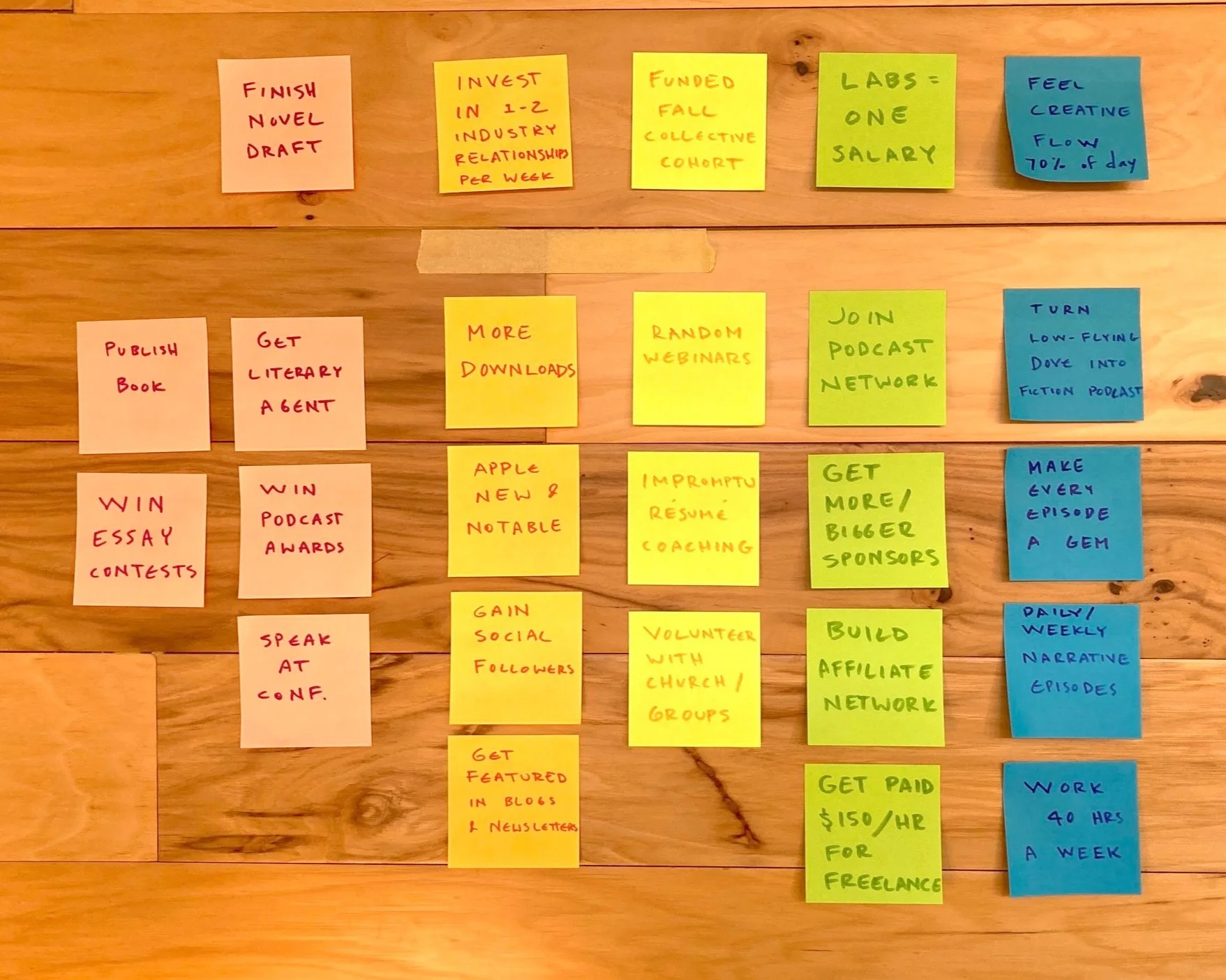
Shelter in Place “25/5” exercise ▫︎ March 2022
Reflection ▫︎ starting from scratch
Anniversaries are a natural time to reflect, and March 2022 was the two-year anniversary of Shelter in Place. Some of those general notes we interspersed in the Happy Anniversary episode, but of the observations that came up were most applicable to our fellow podcasters — you! So the majority of this reflection will not strictly be about one particular episode, but about all we’ve learned these last two years. We’ll also spend some time discussing our own answers to the Warren Buffett-inspired prioritization exercise, or to answer questions that many of you might have: after two years and 200 episodes, what would you do the same, and what would you do differently? Or more bluntly, how do you not podfade? Let’s dive in.
The statistics vary, but last time we looked it up, we saw that there are about 4.5 million podcasts out there in the world. But less than a quarter of those are active, (having released an episode in the last 90 days). So what do we take away from this? That podfade, the unplanned, fatigue-and-burnout-driven disappearance of a show into the night, is a real danger. Because hey, podcasting is hard! And high-quality, scripted, narrative podcasting like we’re doing here is even harder!
So how do you not podfade? How did we not podfade? While in one sense this module is about the practical details of starting from scratch, it’s really about starting well: aligning intentions, actions, and conditions, as the first exercise sums it up. Or to put it another way, “beginning with the end in mind,” to quote Stephen Covey in 7 Habits of Highly Effective People. In this case, the end is not just avoiding podfade, but avoiding CREATIVE fade and LIFE fade. So let’s talk about starting from scratch well.
But first to set the context, here’s this fantastic quote from Hunter S. Thompson. This thought crystallized both our perspective on the past two years, and framed the prioritization exercise which will guide us going forward: He said, “Beware of looking for goals. Look for a way of life. Decide how you want to live and then see what you can do to make a living within that way of life.”
Lemme repeat that, because it’s so important: “Beware of looking for goals. Look for a way of life. Decide how you want to live and then see what you can do to make a living within that way of life.” (Spoiler alert: we spent a lot of the last two years focused on goals. Who makes a season that’s A HUNDRED episodes long? Anyway, that led to some invaluable lessons and worthwhile accomplishments, as Laura discussed in “performance review” — but has also pushed us to burnout.) So now that we have the context of a way of life, let’s zoom in to individual activities.
We’ll actually start with the Buffett-inspired exercise, and then back out to talking about the same/different list. We’ll put the link to the article under the Further Growth section, but to sum up, the exercise goes like this: write down 25 career-related goals. Then pick your top five, and just work on those. It’s not “do the other 20 when you have time.” It’s not “time-block your calendar to make space for all 25.” And neither is it “forget about those other 20 forever.” But what makes it so ruthless is that Buffett argues that you should forget about those 20 lower-priority goals until you have achieved success at your most important five.
For those of you keeping score at home (hint: that should be all of you), the exercise isn’t saying those other things are not bad things, or not valuable things — it’s really just another way of describing the “four burners” theory: you can’t do everything well at once, and you have to make tradeoffs. For those of us who are curious and interested in many things and love variety, this is not what we want to hear. But it’s what we need to hear.
As you can see from the photo, we color-coded the goals into five rough categories: pink for writing-related goals, orange for promotional goals, yellow for training and mentorship, green for financial, and blue for workflow and process.
My biggest takeaway, looking at the five items we left above the line today, is that many of the things we did these past two years (below-the-line items in this reckoning), were not a waste of time — but pursuing them all (and many of them individually) was not sustainable.
Starting from the right with the blue category, the daily and weekly narrative episodes have been an invaluable learning experience, helped us build a platform, and gave us the expertise we are now passing on in our two training programs, but the cost was burnout. If we do another 200 episodes in the next two years, we won’t be twice as knowledgeable — we’ll be dead. So as much as I appreciate the rigor and accountability and sense of accomplishment and creative energy we get from the weekly narrative episodes, I reluctantly came to terms with reality (and our true top five goals) and left that one below the line.
Continuing in the blue “work process” category, “Work 40 hours a week” is a long-term aspiration, but we have to accept, just isn’t realistic given the other things we’re trying to accomplish. “Turn low-flying dove [Laura’s in-progress novel] into a fiction podcast” is an exciting, potentially all-consuming idea we just have to postpone for now. “Make every episode a gem” is something we have achieved for much of the last two years (along with speaking at conferences, winning awards, and getting featured in some newsletters) — but again, the cost has been burnout. It’s important to note here that, as we’ve mentioned before, podcasts exist in a comparative shopping environment: there’s always another show just a few taps away. The hard truth is that you probably have a couple minutes to make a good impression on a new listener. But when you add to that the question “What if this is the one episode that some network executive listens to?” it makes for a very high-pressure creative environment. We’ve been working under that pressure for much of the last two years, and while it has prompted us to go the extra mile many times, it’s exhausting and unsustainable for us. Making episodes in these long, indeterminate seasons, in a real-time, deadline-driven setting has forced us to learn a lot, and fast, but in the future, one major shift we could make to be able to survive is switch to planned, limited-run seasons (like normal podcasts!) which we mostly, or completely, create in advance.
The one process goal above the line is about flow, which we realized is the most precious thing work can give us. There have been many articles written about flow in recent years (we’ll put a link under Further Growth, but in case this is a new idea for you, we like this definition: “Flow -- the mental state of being completely present and fully immersed in a task -- is a strong contributor to creativity. When in flow, the creator and the universe become one, outside distractions recede from consciousness and one's mind is fully open and attuned to the act of creating. There is very little self-awareness or critical self-judgment; just intrinsic joy for the task.”
The reason that flow is so important is that it’s something that no one can take away from you. You can enter award shows and not win. You can help someone and have them not be grateful. You can make amazing episodes and have no one react. But flow — enjoying the process — is completely intrinsic.
Our intent going forward (and something we did not do enough of the past two years) is organize our days so that we protect the times and situations where we could experience flow. Also, looking ahead, many of the items below the line are ones less about flow (joy in the process), and more about external success or things beyond our control.
Moving to the green category, choosing to focus most of our financial efforts on making Labs pay one of our salaries frees us from worrying about the other green below-the-line goals: podcast network, sponsor, and affiliate goals are all nice to have, but will just have to wait. Getting paid $150 an hour for freelance work would be an ego boost — but doing freelance work is time taken away from the top five.
Looking at the yellow category, we realized that teaching and mentoring is really important to us. Deep down, most creative people want to change the world in some way, and mentorship is a way to do that directly, and is a beautiful hedge against the emotional roller coaster of our own creative work. But if we don’t want to lose our house, we can’t afford to donate as much of our time in 2022 as we did in 2021, which is why “funded” is a key word along with “fall Collective cohort.” So to tie off the yellow category, we are just accepting that for now, we need to say no to any other mentoring or volunteer work.
The orange category is interesting, because the four things below the line we spent a LOT of time on that past two years, and while some of those activities are just table stakes for doing creative work in the digital age, they are mostly things that feel like chores (i.e. NOT conducive to flow), and mostly success markers out of our control. The notable exception is investing in relationships. The word “relationship” is very intentional because for us it means not merely transactional, ongoing, and involving real conversation. We’ve found that number one, podcasting is full of generous, welcoming, positive people, and number two, having live phone or video calls (preferably not more than two in a day) makes us feel energized and inspired. And then, as a result of genuinely getting to know another person, some cross-promotion activities may come up. But looking at promotion as a by-product rather than an ulterior motive makes it feel more fulfilling.
Finally we come to the pink category, writing-related goals. The one above the line — finish novel draft — is something Laura was pecking away at pre-pandemic, and now after this beyond-intense two-year dive into podcasting, is ready to get back to. The other pink, below-the-line items, are either things we did the past two years, or later goals that will resurface after the novel draft is done. But for summer 2022, we’re going to put entering more award shows and contests, speaking at conferences, looking for a literary agent, and trying to publish a book on the shelf.
But to sum up the “what we’d do the same versus what we’d do different” way of assessing the last two years, or how to start from scratch well, here are the things I’d do the same: giving myself public accountability and deadlines. Getting help (from Sarah as Design Director, and then me as Creative Director and partner). Regularly asking for ratings and reviews was something else we did right. Speaking at conferences takes a lot of time and prep, but is something I would do the same since it’s led to important industry relationships and gives credibility. Something I wish I’d done sooner was connect more with other podcasters on Twitter, through newsletters, blogs, and so forth. People in podcasting are so great, and the encouragement would have been helpful.
Something I wish we’d done differently is figure out who our core listeners were sooner, whether through a Google Form, email, or in-person conversations. After Laura had a conversation with Callie, the host of Queersplaining, we went down a Patreon rabbit hole trying to plan all these sponsorship tiers, think about bonus material — all the things that work great for Callie’s show, where the core listeners are a passionate niche: LGBTQ+ folks who are more young, single, and online. But for us, as the consensus from our long-running listener survey eventually built up, we saw that our core listeners were a lot of people like Laura: busy working moms who didn’t have the time or need for bonus material. If they were going to support us, it was simply because they appreciated the show, not because they wanted more stuff.
Another really big thing we wish we’d done differently is file for nonprofit status as soon as we realized we were going to be committed to the Kasama Collective mentorship and training program. If we’d been able to apply for grants a year ago, we would probably be in a much different financial position! And getting back to the “conditions” category from the first exercise, tuning in to how big of a cultural and workplace theme diversity, equity, and inclusion efforts are could have helped us a lot earlier.
And then two other things that were not a waste of time, but which we did backwards, were entering award shows, and pitching to podcast networks. I wish we’d entered award shows a lot sooner (even toward the end of season one), rather than waiting until I first did it, almost on a whim, this past August (beginning of season three, over 130 episodes in). The first two conversations we had with networks most likely would have gone differently if we’d had either the IWPA or Golden Crane on our resume. And the final thing I wish we’d done differently is be more consistent about sending out email newsletters. Many people have told us about the value of newsletters, and wome simple calendar-blocking could have helped us do this every two weeks, rather than simply happenstance moments when it occurred to us.
We’ll look forward to hearing your own reflections from these exercises in this week’s coaching call or on Slack. Here’s to not podfading!